- Decomposing monolithic prompts into specialized worker agents reduces hallucination rates by up to 80%.
- Stateful Directed Acyclic Graphs (DAGs) enable deterministic pause, resume, and human-in-the-loop review checkpoints.
- Hybrid memory architectures combining vector search with episodic key-value logs prevent context window exhaustion.
Over the past eighteen months, the AI ecosystem has transitioned from novelty chatbot interfaces to autonomous agent systems capable of orchestrating multi-step business operations. However, taking AI agents from proof-of-concept prototypes to reliable enterprise production remains notoriously difficult.
Single-prompt agent architectures quickly degrade as task complexity grows: context windows overflow, hallucination risks compound with each step, and tools fail without clear rollback mechanics.
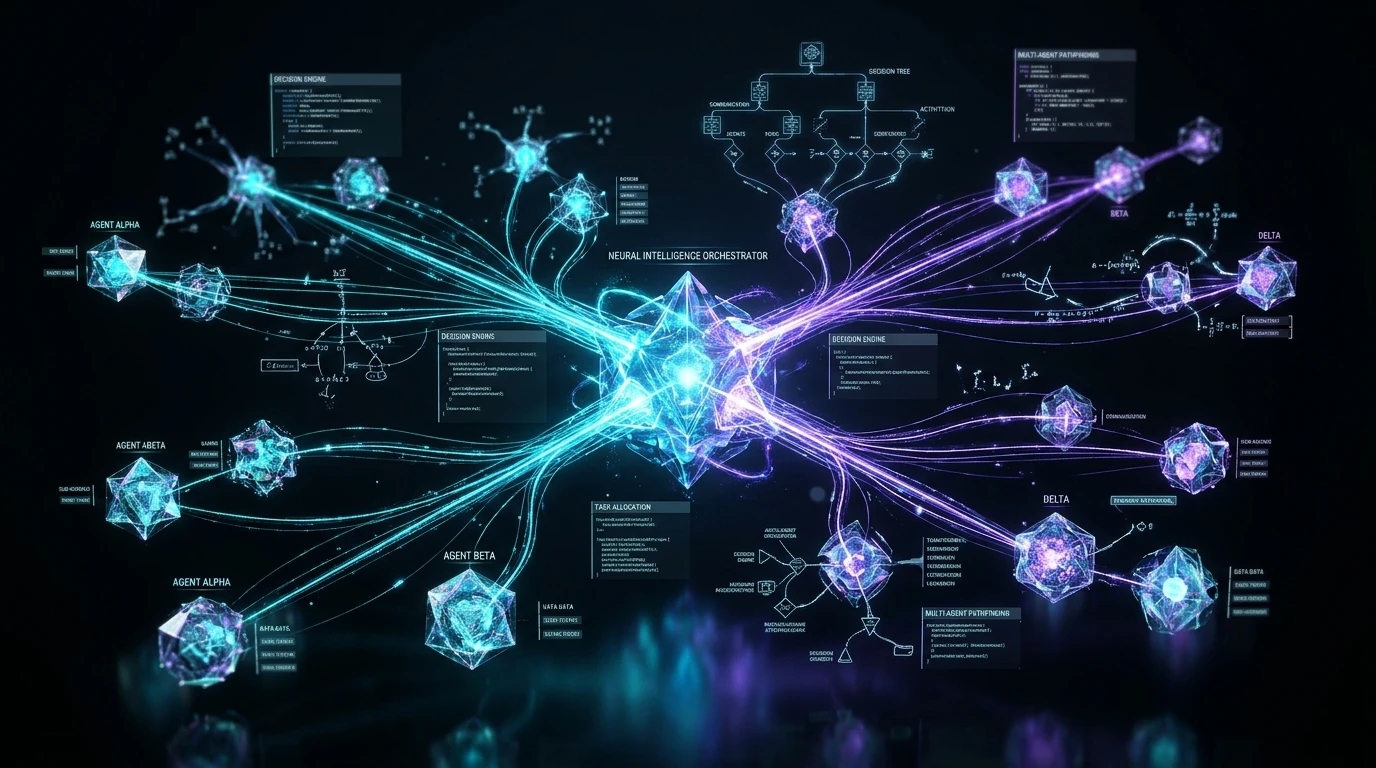
To achieve production stability, modern AI engineering employs multi-agent graph topologies. In this architecture, specialized agents collaborate under a centralized supervisor, maintaining persistent memory and executing tools bounded by deterministic validation schemas.
1. Multi-Agent Graph Topology: Supervisor vs. Mesh Patterns
In naive agent implementations, all agents pass messages freely in an unstructured mesh. This frequently leads to infinite conversational loops, repetitive question-asking, and unpredictable token consumption.
Production systems implement hierarchical supervisor topologies. A lead orchestrator agent evaluates the user prompt, formulates a declarative execution plan, and dispatches sub-tasks to purpose-built domain agents (e.g., Code Researcher, Database Querier, Compliance Auditor).
Each worker agent operates inside a strictly scoped context window with access only to the specific tools required for its domain, preventing tool selection confusion and reducing input token costs.
- Supervisor Agent: Routes tasks, enforces business rules, aggregates final responses.
- Domain Workers: Isolated agents with specialized prompts and tightly restricted toolsets.
- State Checkpointer: Persists the full execution graph after every step for auditability and recovery.
2. Stateful Graph Orchestration with LangGraph
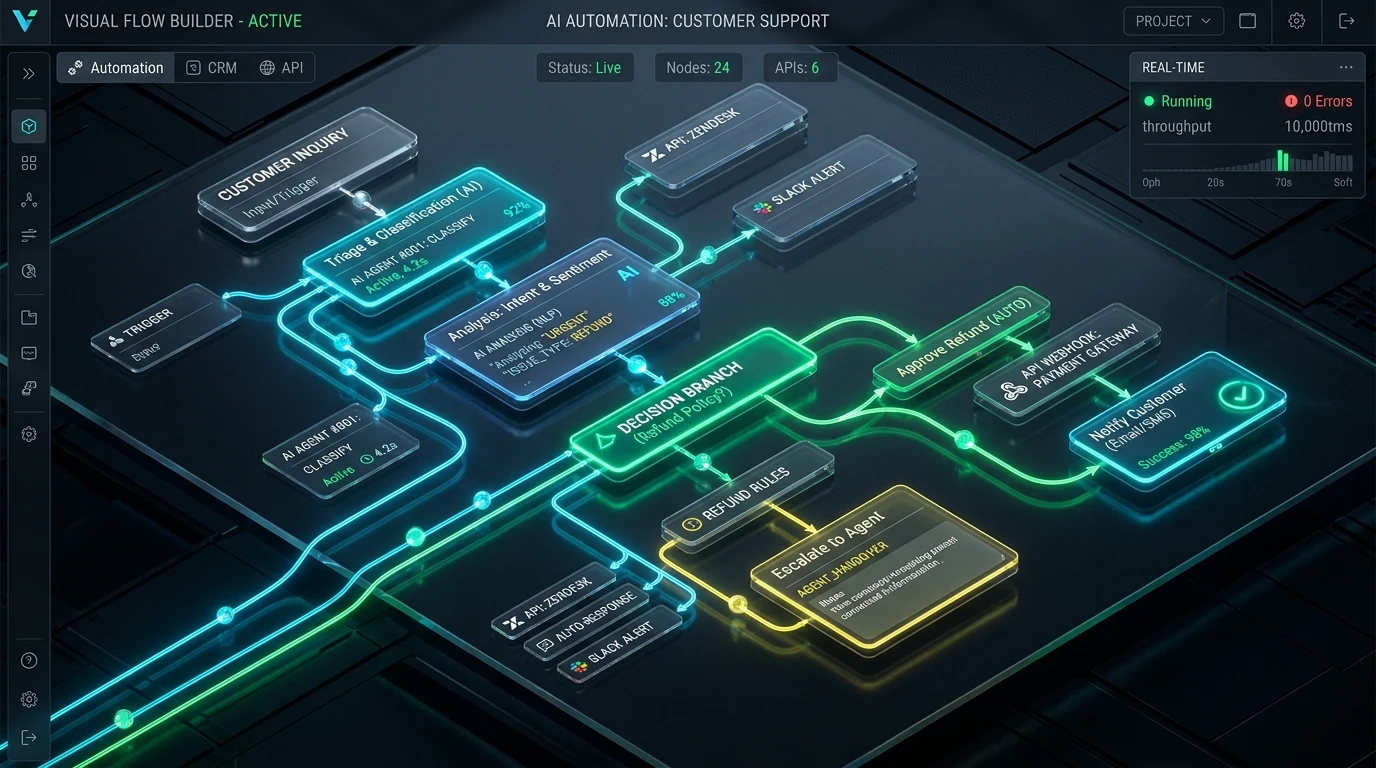
Rather than treating agent execution as an opaque black box, stateful graph engines model agent workflows as state machines. Nodes represent compute tasks (LLM inferences or tool executions), and edges represent conditional transitions.
This enables deterministic guardrails: if a worker's output fails schema validation, the graph can automatically route back to an error correction node rather than crashing the pipeline.
import { StateGraph, END } from "@langchain/langgraph";
import { z } from "zod";

// Define the unified agent graph state
interface AgentWorkflowState {
  objective: string;
  assignedAgent: "researcher" | "coder" | "reviewer" | "complete";
  extractedData: Record<string, unknown>;
  retryCount: number;
  isApproved: boolean;
}

// Build the state graph
const workflow = new StateGraph<AgentWorkflowState>({
  channels: {
    objective: { value: (x, y) => y ?? x, default: () => "" },
    assignedAgent: { value: (x, y) => y ?? x, default: () => "researcher" },
    extractedData: { value: (x, y) => ({ ...x, ...y }), default: () => ({}) },
    retryCount: { value: (x, y) => y ?? x, default: () => 0 },
    isApproved: { value: (x, y) => y ?? x, default: () => false },
  },
});

// Conditional edge routing based on supervisor evaluation
workflow.addConditionalEdges("supervisorNode", (state) => {
  if (state.isApproved) return END;
  if (state.retryCount > 3) return "humanReviewFallback";
  return state.assignedAgent;
});
3. Tiered Long-Term Memory Architecture
Context windows in modern frontier models are large, but dumping entire message histories into every prompt degrades reasoning quality and inflates latency. Production agents require tiered memory architectures.
Working Memory stores the immediate conversation turns and active tool outputs. Semantic Memory utilizes vector embeddings to retrieve relevant historical documents and precedents. Episodic Memory preserves structured session summaries so agents recall customer preferences across multi-day interactions.
“Reliable autonomous agents do not emerge from prompt wizardry; they emerge from disciplined systems engineering: typed state machines, bounded memory, and deterministic validation at every node.”
— Marcus Vance, DINVEXA AI Team
4. Deterministic Tool Execution & Idempotency
When an AI agent triggers external actions—such as charging a credit card, updating an ERP database, or dispatching an email—every tool call must be idempotent. If a network blip occurs during agent execution, re-running the node must never duplicate real-world transactions.
We enforce idempotency keys across all tool schemas, validate input arguments using strict runtime schemas (Zod/Pydantic), and wrap state transitions inside transactional database units of work.
Final Architectural Thoughts
Autonomous multi-agent systems represent the frontier of modern software engineering. By moving from loose prompt chains to typed state graphs, bounded memory, and deterministic tool execution, companies can deploy AI workflows that deliver enterprise-grade accuracy and continuous business value.
At DINVEXA, we architect, test, and deploy custom AI agent infrastructure tailored for high-stakes enterprise applications.
Marcus Vance
AuthorAI & Automation Engineer
Senior engineer at DINVEXA specializing in scalable web systems, automation graphs, and modern full-funnel digital architecture.