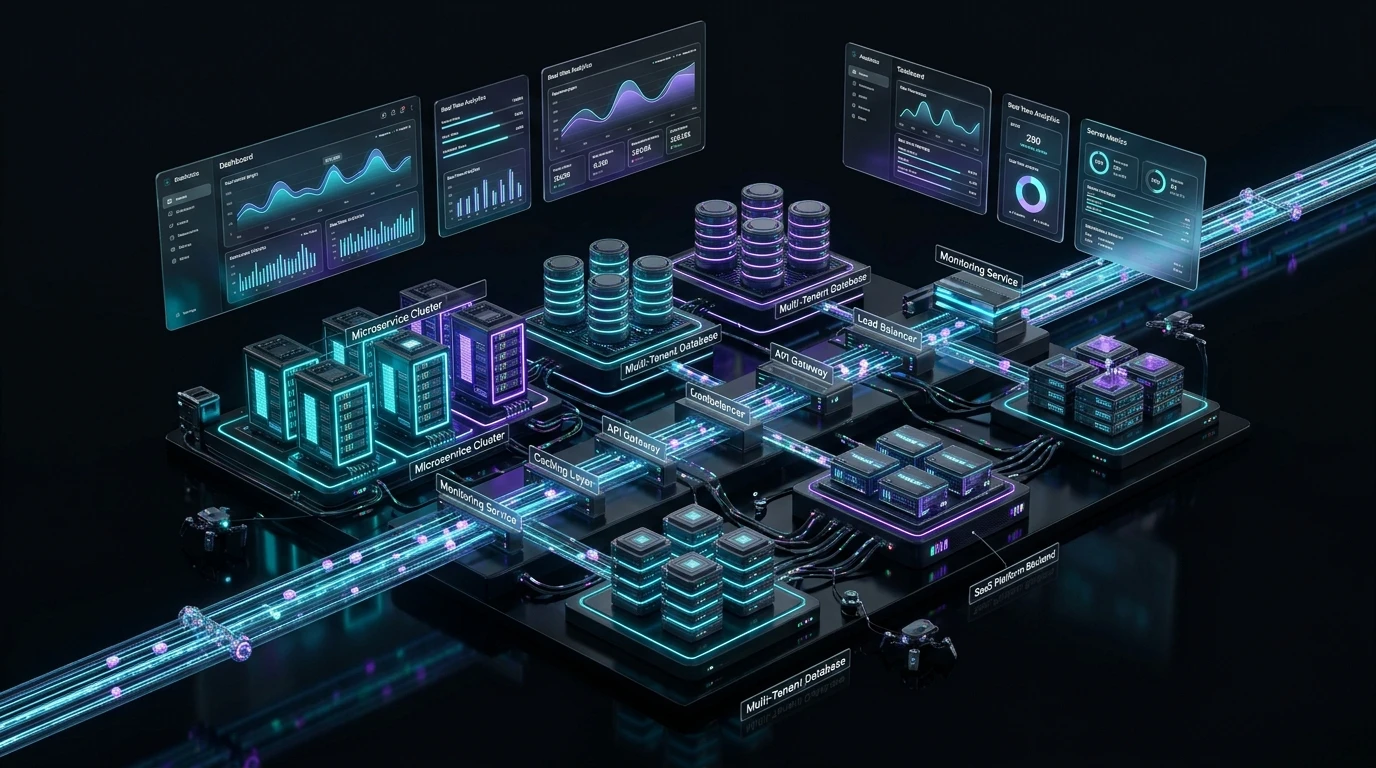
- PostgreSQL Row-Level Security (RLS) provides kernel-enforced data boundaries without the overhead of per-tenant database instances.
- Connection pool exhaustion is mitigated using transactional pooling proxies (pgBouncer/Supavisor) configured per tenant tier.
- Metered usage aggregation should be offloaded to asynchronous event streaming queues to eliminate write contention on primary billing tables.
Building a scalable Software-as-a-Service (SaaS) application requires balancing two competing priorities: infrastructure cost efficiency and absolute tenant data isolation. In the enterprise tier, a single customer data leak can fatally destroy business credibility.
Early-stage SaaS startups often default to naive database designs—either creating separate database instances for every small customer, causing infrastructure bills to explode, or using simple WHERE tenant_id = ? clauses without database-level protection, risking catastrophic cross-tenant data leaks.
In this architectural guide, we break down the production patterns DINVEXA implements to scale multi-tenant B2B SaaS platforms to thousands of enterprise organizations while maintaining ironclad security and predictable operating margins.
1. The Isolation Spectrum: Silo vs. Pool Architectures
Tenant isolation is not binary; it sits on a spectrum ranging from fully isolated silo databases to shared pooled tables. The optimal choice depends directly on compliance mandates, customer tiers, and unit economics.
In a pooled database model, all tenants share a unified database and schema. Tenant rows are separated via a partition key (tenant_id). This offers maximum compute utilization and simplified database schema migrations, making it ideal for self-serve SMB tiers.
For enterprise compliance (e.g., HIPAA, SOC2 Type II, dedicated data residency), a hybrid model is superior: pooled tables for standard tiers, with dynamic routing middleware capable of transparently delegating enterprise tenants to dedicated regional shards.
- Pooled Model: Lowest cost per tenant, effortless global analytics, instant provisioning.
- Silo Model: Absolute hardware and encryption isolation, customizable backup schedules, zero noisy-neighbor risk.
- Bridge/Hybrid Model: Shared application code with metadata-driven connection routing to pooled or dedicated databases.
2. Ironclad Tenant Isolation with PostgreSQL Row-Level Security
Relying on application developers to remember WHERE tenant_id = current_tenant in every SQL query or ORM call is an accident waiting to happen. A single missed filter in a complex join exposes sensitive records across organizations.
By enabling native PostgreSQL Row-Level Security (RLS), the database engine itself enforces the boundary. Even if application code executes a raw SELECT * FROM invoices;, Postgres evaluates the current session variable and strictly returns records belonging to the authenticated tenant.
-- Enable Row-Level Security on critical SaaS tables
ALTER TABLE organizations ENABLE ROW LEVEL SECURITY;
ALTER TABLE projects ENABLE ROW LEVEL SECURITY;
ALTER TABLE invoices ENABLE ROW LEVEL SECURITY;

-- Create policy enforcing tenant access based on transaction context
CREATE POLICY tenant_isolation_policy ON projects
  AS RESTRICTIVE
  USING (tenant_id = NULLIF(current_setting('app.current_tenant_id', true), '')::uuid);

-- Application middleware sets context per request transaction
BEGIN;
SET LOCAL app.current_tenant_id = 'a1b2c3d4-e5f6-7a8b-9c0d-1e2f3a4b5c6d';
SELECT * FROM projects; -- Strictly returns only tenant projects
COMMIT;
3. Connection Pooling and Preventing 'Noisy Neighbor' Outages
In multi-tenant SaaS, a single customer running heavy automated report exports or experiencing a viral traffic spike can saturate the database connection pool, taking down the entire service for all other tenants.
To solve this, we deploy transactional connection poolers with tier-aware quota limits. High-frequency queries share short-lived pooled connections, while long-running analytics jobs are routed to read-only replicas with strict execution time limits (statement_timeout).
“Multi-tenancy is not just a database schema decision; it is a resource allocation contract. If your architecture cannot isolate a runaway customer script, your platform is not enterprise-ready.”
— Alex Vance, DINVEXA Systems Architect
4. Asynchronous Metered Billing & Usage Aggregation
Modern B2B SaaS models increasingly adopt usage-based pricing—charging per API call, token consumed, or gigabyte processed. Attempting to increment user balances in synchronous transactional tables creates massive write locks.
Instead, application workers emit lightweight telemetry events to a high-throughput message stream (Redis Streams or Apache Kafka). A background consumer batches events into five-minute windows, aggregates metrics per tenant, and synchronizes with billing engines like Stripe or Lago without degrading core application latency.
Final Architectural Thoughts
Engineering an enterprise-grade multi-tenant SaaS platform requires anticipating growth bottlenecks before they occur. By combining PostgreSQL Row-Level Security, connection pooling proxies, and decoupled metered event pipelines, software founders can scale confidently from their first ten users to hundreds of thousands of paying organizations.
At DINVEXA, our engineering squads specialize in designing and auditing custom multi-tenant backends engineered for bulletproof reliability.
Alex Vance
AuthorLead Systems Architect
Senior engineer at DINVEXA specializing in scalable web systems, automation graphs, and modern full-funnel digital architecture.